

Intro to Coil Shocks
Published: February 2026

What's The Deal With Coil?
At clinics, events, and factory tours we often get numerous questions about coil shocks. With their heavy-duty aesthetic, they certainly catch the eye. To many, a coil shock just says: “suspension,” yet they remain shrouded in mystery. So, why are they desirable to some but not all? What makes coil shocks special? Let's dive in.
What Does Coil Suspension Offer?
Coil suspension’s number one appeal can be summed up in one word: sensitivity. When encountering bumps (especially small, high-frequency ones) coil suspension is generally observed to feel more active – more supple and sensitive – as it compresses over them. In this case, when we say sensitive, we mean that it takes very little energy to get the suspension moving. This translates to a smooth ride that seems to soak up chatter easier and mute rough trails with relative ease. It must be acknowledged that when air suspension is new or freshly serviced, it can come very close - if not surpass - this performance, but in reality, very few of us service our suspension as often as we should. As air suspension gets dirty and worn, the seals that make the system airtight can start to create additional friction – degrading that luscious sensitivity that we all crave from high end suspension.
The second major characteristic of coil suspension is the way in which coil springs build force when they compress. A coil spring is usually linear in nature. This means that the amount of force required to compress the spring increases by the same amount every inch that it’s compressed. It’s a very steady increase that generally does not build as much ending force compared to an air spring. (not as much “bounce” pushing back at you from full bottom out) This makes it easier to access the final part of the stroke - a good thing if you’re trying to maximize every millimeter of travel to soak up impacts and keep your bike planted on the trail at high speed. As a result, riders typically find that coil shocks feel more predictable as they’re getting to those moments when they’re deep in the travel on a large impact or compression. Coil springs can make tuning your damper settings simpler, since the spring behavior is more consistent throughout its stroke.
For both of these reasons – linear spring rate and sensitive response – coil suspension often results in a more planted feel on the trail when compared to air suspension. In other words, it's pretty great for going fast downhill.

If they’re so great, why aren’t coil shocks more popular?
Just about every full suspension mountain bike comes with an air shock. This is mostly because of the business of selling bikes. Air shocks make it easy for a wide variety of riders to quickly get set up on the same bike. You step into the bike shop, ask to test ride a bike, and in minutes, a shop employee can adjust the air pressure to your needs without taking the bike apart or needing to stock additional items. Coil shocks require different springs for each rider, based on the rider’s weight. To figure out which coil spring you need, you have to do some math and then remove the shock from the bike and physically swap the coils. This takes more time, money (in additional springs), and know-how. It’s for this reason that most bike companies don’t design their bikes to come with coil shocks out of the gate – it would simply making buying a bike more complicated.
Not to mention, coil shocks are heavier. On average, a coil shock adds about 200-300g of weight over a comparable air shock. This is not very relevant (and can even be considered a benefit) on gravity-oriented bikes that are primarily used for going downhill. However, on a bike of more up-and-down persuasions, it can certainly be a big weight penalty.
Who Are Coil Shocks For?
Put simply, coil shocks tend to be chosen and loved by riders the prioritize descending. Their confidence-inspiring, planted feel and supreme sensitivity make coil shocks a treat when your whole ride is built around the time spent going down.
Do you find yourself regularly seeking out prolonged mountain descents of 5 minutes or more? Do you ride in supremely rough and chunky areas where active suspension movement is critical? If yes – try coil.
Conversely, if you live and ride in an area with short downhills (several minutes or less at a time) and plenty of high-tempo pedaling in between, then an air shock might make your bike feel more alive and efficient.
Coil shocks are also fantastic for the rider that wants minimal reasons to fuss with their suspension. Since coil shocks are inherently less tunable than air shocks, they’re great for dialing in your initial setup and then just riding day in and day out without thought or concern for adjusting air pressure and volume. They also don’t respond dramatically to temperature and altitude changes. They’re a great choice for riders that would rather operate under the adage of “set it and forget it!”
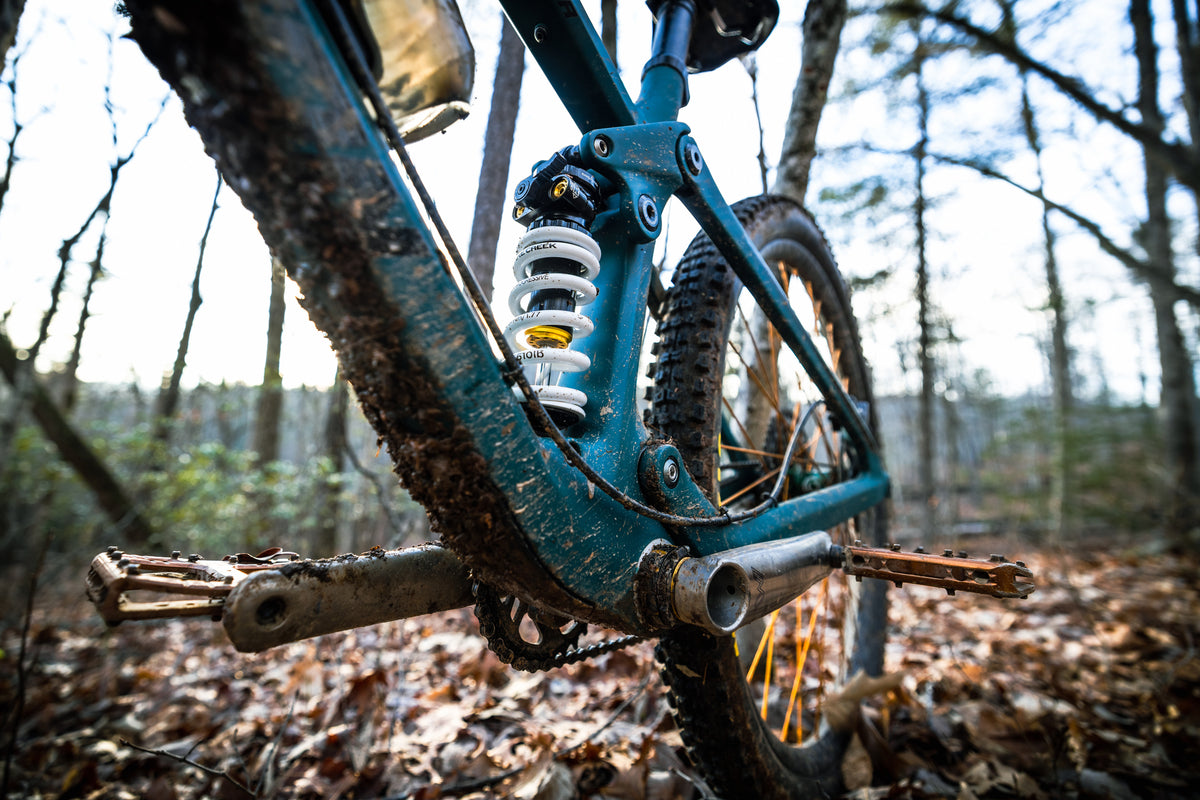
What Bikes Are Best Paired With Coil Shocks?
Due to their linear nature, coil shocks typically are best paired with bikes that feature progressive suspension kinematics. In the context of discussing bike frame design, the term progressive means that the leverage that the frame exerts on the shock is very high initially, and then decreases as the bike moves through its travel. This means that towards the end of travel, the rear triangle and linkage have much less leverage to compress the shock. This gives the suspension more support at this stage, making it harder for the frame to bottom out the shock. Bike manufacturers will sometimes list the progression of the suspension with their bike’s specs online. Look for a change in leverage that’s about 20% or more for ideal coil compatibility. If your bike is not very progressive, or you know it was strictly designed for air shocks, you can use one of our progressive VALT springs to add some additional end-stroke support.
When it comes to mounting considerations, coil shocks are best used on bikes that do NOT use a clevis mount – that ‘u’ shaped yoke that connects the seatstays to the shock bypassing the seat tube. This shock mounting configuration is safe for air shocks because they use bigger tube sections that can withstand the additional torsional side loads that clevis mount can impart. Since coil shocks often have just a skinny damper shaft exposed, they can be more susceptible to wear and damage when used with clevis-mount bikes.
A Note on the Cane Creek Tigon
Perhaps you have a bike with low progression and/or clevis mount design but still want to run a coil shock? Tigon is the answer. Our novel air-charged coil shock addresses the issues listed in the section above, giving you a shock with coil performance in a package that’s compatible with bikes that were designed to only accept air shocks. Tigon’s RAMP Tube is a small, secondary air spring that allows you to use a shock pump to tune the end-stroke support and add progression to an otherwise linear coil shock. Tigon still offers that coil shock sensitivity and mid-stroke support, but it also gives the progression that many frames require for resisting harsh bottom outs. The RAMP Tube anatomy of the shock also makes it strong enough to resist the side loads often introduced by clevis-mount designs.
What About Forks? Can They Be Coil?
They sure can! At Cane Creek, we make one of the last options for a coil-sprung fork on the market today. Our Helm MKII can be built with either an air or a coil spring. The air fork can be converted to coil if you’re interested in giving that a try.
Coil forks offer high levels of sensitivity and a planted feel. Like coil shocks, setting spring rate is a one-and-done affair, free from the urge to mess with the shock pump before every ride. There’s nothing like the feeling of pushing into the first several inches of travel on a coil fork – it requires amazingly little force and likely feels smoother than most air forks you’ve felt.
That said, coil forks are heavier, have less bottom out support, and they can exhibit ‘top-out,’ a small clunk that can be felt as the fork returns to full travel. This is because the minimal rebound damping that most riders prefer in mountain bike forks is not enough to account for the fact that there’s no negative air spring to counteract the positive one. It’s a feeling that coil fork riders know and accept, but it can be disconcerting to riders who expect a coil fork to feel and sounds just like an air one.